
Women’s History Month HerStory A Blueprint of Power and Purpose: Edith Lerrigo’s Invocation for Dr. Dorothy I. Height (1973)
By Margaret Mitchell, CEO
YWCA USA
In March 1973, executives, friends and colleagues from across numerous organizations gathered for a tribute dinner honoring Dr. Dorothy Irene Height’s extraordinary leadership and the National CEO of YWCA USA, at that time, Edith Lerrigo, offered an invocation. It was more than a ceremonial prayer. It was a leadership manifesto. A declaration of collective responsibility. A blueprint of Dr. Heights daily intentions. And it still resonates today.
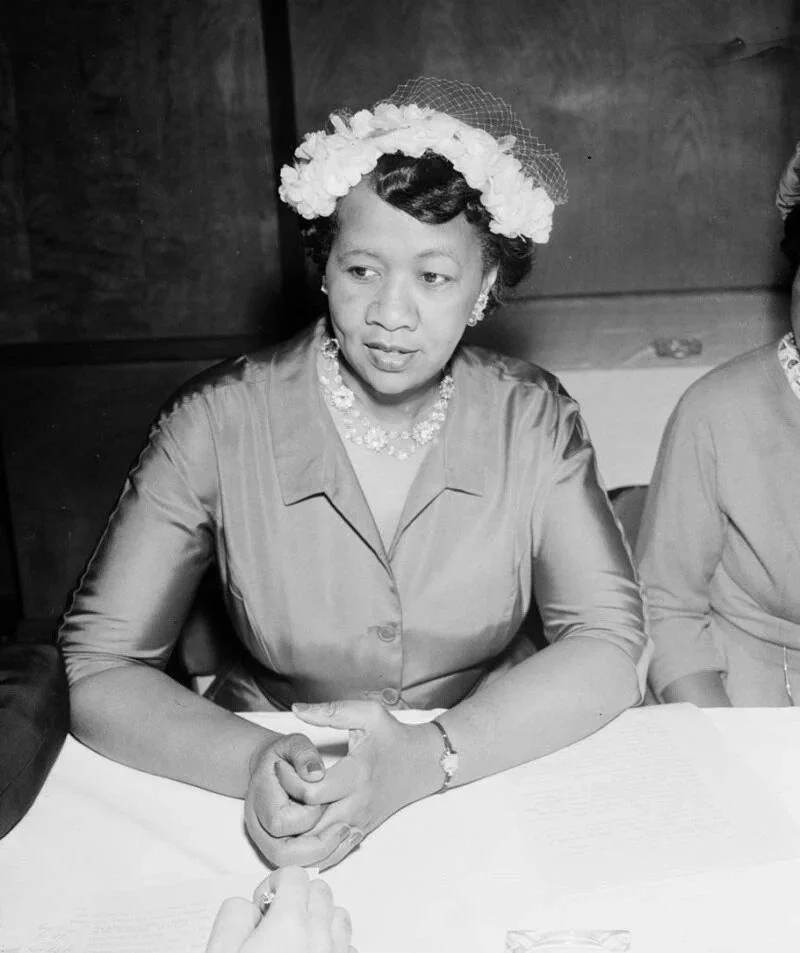
At that moment, Dr. Height had already devoted nearly 38 years to the YWCA movement—most of that time serving as YWCA USA’s Director for the Center of Racial Justice, where she shaped the organization’s racial justice agenda, strengthened its national voice, and guided Local Associations through some of the most turbulent decades in American history. At the same time, she served as President of the National Council of Negro Women, uniting millions of Black women in the fight against poverty, racism, and systemic inequity.
Leading two national institutions simultaneously, each rooted in justice, demanded a discipline, diplomacy, and moral clarity that elicits awe. Those who served alongside her described Dr. Height as strategic yet gracious, resolute yet relational. Civil rights leaders called her the “conscience of the movement.” Eight Presidents of the United States sought her counsel. Women on the frontlines doing critical grassroots work trusted her voice.
Lerrigo began the invocation that evening, just a few weeks before Dr. Height’s birthday on March 24th, in gratitude for “the life of our beloved friend and colleague, Dorothy Height.” From the outset, the tone was clear: leadership was framed not as celebrity, but as contribution. Not as personal acclaim, but as progress shared with all women.
She named Height’s “blazing wisdom, boundless energy, persistent courage, and deep devotion to… love and justice.” Each phrase reads like a leadership standard. Blazing wisdom speaks to intellectual rigor and foresight. Boundless energy reflects stamina over decades of sustained work. Persistent courage signals endurance in the face of resistance. Devotion to justice underscores unwavering purpose.
This was not flattery. It was recognition of real impact. Dr. Height helped move YWCA USA from cautious conversations about race to explicit, organizational commitments to racial justice. She pushed institutions to align words with action, and she did so through steady strategy and disciplined execution.
Lerrigo then widened the lens, acknowledging “all the lives she has touched and influenced and set on the road to freedom.” This freedom was not abstract, but practical and intergenerational realized through expanding opportunity, increasing voices, and creating greater access to power. Height never accumulated influence for her own sake; she multiplied it in others. That multiplication is her enduring blueprint.
The invocation also recognized her presidency of the National Council of Negro Women and her ability to unite “millions of our sisters in the struggle to end poverty and to create a more just and equitable society.” Her dual leadership was not divided allegiance; it was integrated mission. She understood that advancing justice requires coordination across organizations, sectors, and communities.
Perhaps most striking are the closing lines of Lerrigo’s invocation:
“Shatter our pride. Disturb our complacency. Forgive our timid and fearful ways. Enlarge our minds and hearts and imaginations.”
In an era marked by finger pointing, low trust, polarization, and public callouts and cancellations, these words feel especially relevant. They call leaders to humility, not defensiveness. To growth, not entrenchment. To courage that moves beyond fear of criticism.
The message was not about preserving reputation. It was about expanding responsibility.
Dr. Height navigated institutions not originally designed to center Black women’s leadership and expanded them without abandoning them. She maintained relationships across ideological divides without diluting conviction. She believed movements endure when leaders cultivate others, not when they dominate the stage.
Those who knew her described Dr. Height as “quietly unstoppable.” Civil rights leaders credited her with sustaining bridges when tensions ran high. Younger women saw in her not only representation, but possibility. For me, she demonstrates that power and purpose are strongest when exercised in community.
The 1973 invocation reads now as both tribute and instruction. It affirms disciplined, values-driven leadership. It is a call to self-examination; a practice that Dr. Height carried with her throughout her life. It insists that justice is not an episodic backlash, but a sustained commitment.
Women’s History Month invites us not only to honor legacy, but to inherit responsibility.
Dr. Dorothy Height left us a model for leading in polarized times: stay anchored in mission, expand imagination, resist complacency, and build collective power.
In a world searching for trustworthy leadership, Dr. Height’s life's work, and Edith Lerrigo’s words remind us that courage forged not through applause, but by alignment with purpose.
Yes, for YWCA USA our roots were faith informed. Our present is justice-centered. Our future remains radically inclusive. The throughline is moral courage.
To read the invocation written by Edith Lerrigo click HERE (courtesy of the Smith College Special Collection Archives). If you would like to learn more about Dr. Dorothy I. Height and her contributions to the YWCA movement, click HERE.